Graph Neither Left Nor Right Continuous at2 Continuous Only From the Right at 0
Throughout this module, if something does not exist, write DNE in the answer box.
Recap Video
Take a look at the following video which recaps the ideas from the section.
Example Video
Below are two videos showing worked examples.
Problems
A function is continuous at if:
- exists.
- exists.
- .
Remember that the types of discontinuity:
- Removable: exists but is not equal to .
- Jump: (but both of these limits exist).
- Infinite: or is .
For the following graph of a function , decide whether the function is continuous. If not, decide the type of discontinuity.
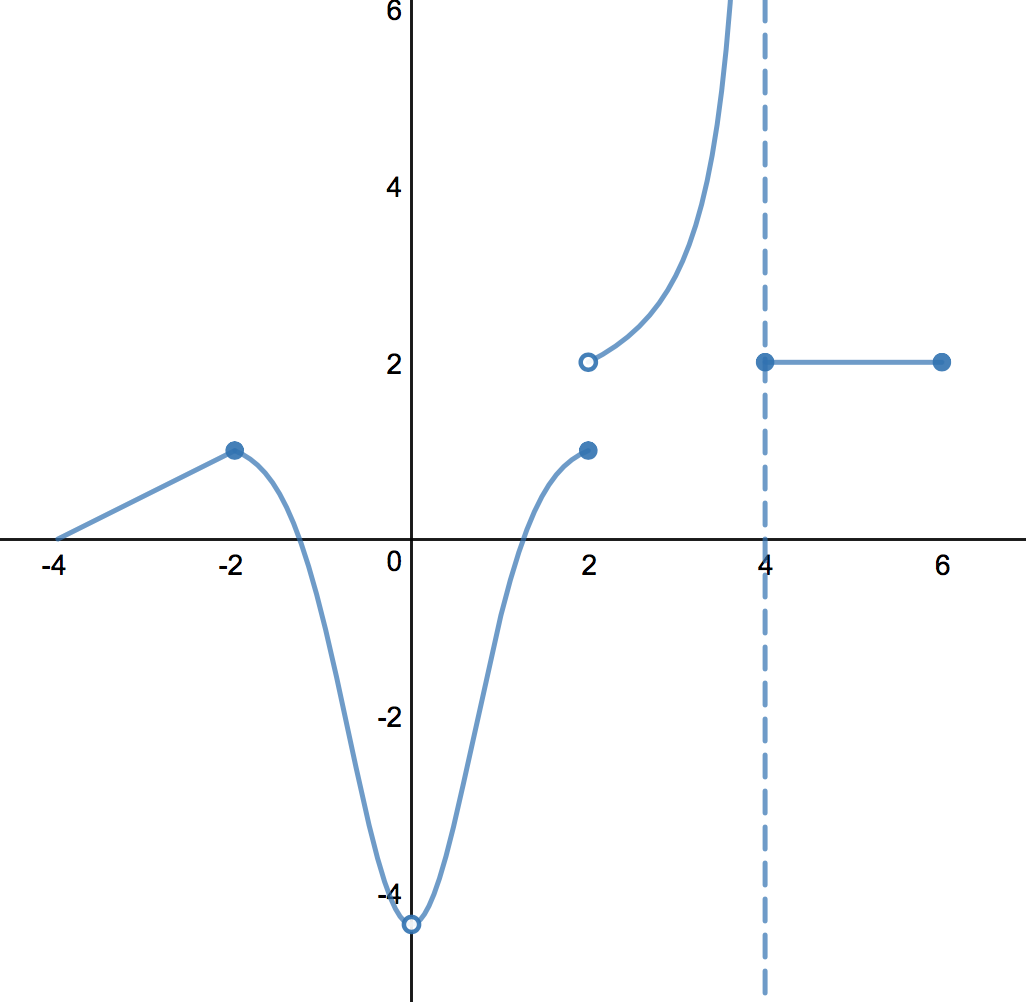
- At : is continuous has a removable discontinuity has a jump discontinuity has an infinite discontinuity .
- At : is continuous has a removable discontinuity has a jump discontinuity has an infinite discontinuity
- At : is continuous has a removable discontinuity has a jump discontinuity has an infinite discontinuity
- At : is continuous has a removable discontinuity has a jump discontinuity has an infinite discontinuity
For the graph below (same graph as previous problem), decide whether the function is right-continuous, left-continuous, both, or neither.
- At : is right-continuous is left-continuous is both left- and right- continuous is neither left- nor right- continuous
- At : is right-continuous is left-continuous is both left- and right- continuous is neither left- nor right- continuous
- At : is right-continuous is left-continuous is both left- and right- continuous is neither left- nor right- continuous
- At : is right-continuous is left-continuous is both left- and right- continuous is neither left- nor right- continuous
Consider the following function Here is some constant.
- Determine whether the function is continuous at . If not, determine the type of discontinuity, and also say whether the function is left-continuous or right-continuous at .
We will check the three conditions in the definition of continuity. First, we check that exists. In this case, we get that , so that condition is satisfied. Second, we check the limit. Since has different definitions to the left and right of , we need to compute the two one-sided limits. To the left of , the function is equal to , and so To the right of , the function is equal to , and so Since the left limit doesn't equal the right limit, the function is is not continuous, and the function has a removable jump infinite discontinuity. Since is equal to the left limit right limit , the function is left-continuous right-continuous at .
- Determine the value of that will make the function continuous at .
The approach is similar to that of the previous part. Notice . For the limit, we will compute the right and left limits separately. A little to the left of , the function is equal to , so To the right of , the function is equal to , so For the limit to exist, we need the left and right limit to be equal, so we need Solving for gives . Notice that this would make the limit , and this would equal the value of the function, so this is the value of which makes the function continuous.
One of the nice things about continuity is that is gives us a quick way of evaluating limits: plug in the point.
Evaluate .
Notice that both the numerator and denominator are continuous at all points, so their quotient will be continuous provided the denominator is nonzero. This means we can plug in to evaluate the limit:
Evaluate .
Since is continuous and is continuous (i.e. polynomials and exponentials are continuous functions), their composition is continuous, and that composition is exactly . Therefore, we can plug in to evaluate the limit:
Remember that in 2.3, we saw that if we plug in the point and get , then we need to do some algebra to figure out the limit, and if we get some other number divided by , then we will have a vertical asymptote of some kind. The same thing applies here.
The limit .
Plug in into the function, which you can do because the function is continuous.
The limit .
When you plug in , you get , so we need to do some algebra. Notice that the denominator factors as Therefore
The limit .
When you plug in , you get , so we have an asymptote. To see whether the limit is , imagine plugging in a small number a tad bigger than . Is the fraction positive or negative?
Intermediate Value Theorem
Intermediate Value Theorem Let be a function which is continuous on an interval . If is any number between and , then there exists a number in the interval such that .
(To think about) Why is it necessary that be continuous? Can you think of what can go wrong if is not continuous?
A root of a function is a solution to . Show that there is a root of on the interval .
First, note that is is not a continuous function, so the IVT can be applied. Second, observe that What this means is that, on the interval , the function must hit every -value between and . Since , we know from the IVT there must be some value in the interval which is a root of .
Show that has a solution.
To help us apply the IVT, let's move all the 's to one side, so we will show that has a solution. The previous problem provided the interval, whereas this one does not, so we will just have to be clever and pick an interval. The goal should be to create an interval such that the -value of lies between the -values of the two endpoints. Let's start with . Notice that if , then This is greater than less than , so we now need to pick a different -value which has a -value greater than . Think about . We can compute which is greater than less than . Therefore, if we consider the interval , we have , so the IVT tells us there is some solution in , which is what we wanted!
Now you can try one:
Show that has a solution.
True/False
Determine whether the following statements are true (meaning always true) or false. If false, try to think of a counterexample.
Suppose is continuous at . Then it must be true that is left-continuous at .
True False
Suppose exists. Then it must be true that is continuous at .
True False
Suppose is a function with a removable discontinuity at . Then it must be true that does not exist.
True False
Suppose is a continuous function. If and , then it must be true that has no solution in .
True False
Suppose is a function with and . Also assume that has a solution for every value of between and . Then it must be true that is continuous on .
True False
crawfordfords1992.blogspot.com
Source: https://ximera.osu.edu/math112/04ContIVT/ContIVT/contIVT
0 Response to "Graph Neither Left Nor Right Continuous at2 Continuous Only From the Right at 0"
Enregistrer un commentaire